JERSEY WEATHER CHAT LIVE OPS
SPACE WEATHER · AURORA WATCHAURORA ALERT
OFFICIAL SPACE WEATHER ALERTS
LIVE SPACE WEATHER
AURORA OVAL · JERSEY
The aurora forms an oval-shaped ring around the magnetic pole. As geomagnetic activity (Kp) rises, that ring expands further from the pole and can push south enough to reach Jersey's latitude — 49.18°N. Because Jersey sits much further south than typical aurora-viewing latitudes, this only happens during severe-to-extreme geomagnetic storms (Kp 7–9). The estimate below is a rough guide based on Kp, not a precise real-time position.
You are looking down on the North Pole, turned so Jersey sits at the bottom. The glowing band is where aurora is likely right now; the dashed ring is Jersey's latitude. To see aurora from the island, the glow needs to reach — or come close to — that ring on the bottom of the picture, because you would be looking north, up the dashed line towards the pole. The real oval is not a neat circle: it bulges further south on the night side.
| KP | 0 | 1 | 2 | 3 | 4 | 5 | 6 | 7 | 8 | 9 |
|---|---|---|---|---|---|---|---|---|---|---|
| OVAL EDGE (°N, APPROX) | 66.5 | 64.5 | 62.4 | 60.4 | 58.3 | 56.3 | 54.2 | 52.2 | 50.1 | 48.1 |
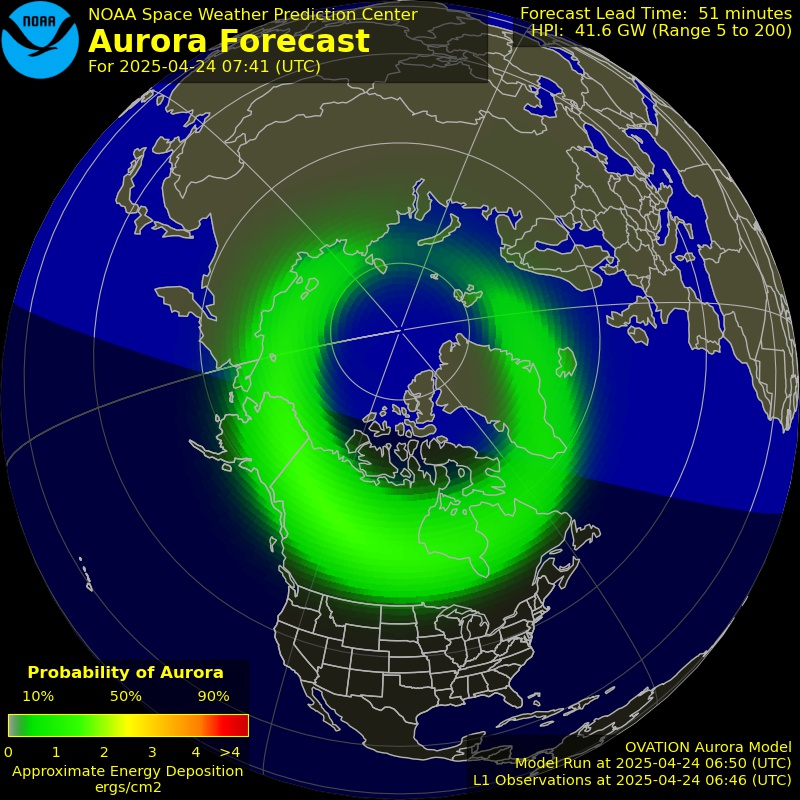
LIVE AURORA FORECAST MAP
LIVE SOLAR IMAGERY
Near real-time views of the Sun itself, straight from NASA/ESA's SOHO and SDO spacecraft. Each instrument looks at something different — sunspots, magnetic field, different layers of the corona, or eruptions heading out into space. Tap a tile below to switch the view. Tap and hold or hover over a button for a description of the image.
BEST VANTAGE POINTS
Aurora appears low on the northern horizon, so the best spots are elevated, north-facing, and away from light pollution. These north-coast headlands give the clearest, darkest sightlines out over the sea — tap a marker for details.
SKY CONDITIONS OVER JERSEY
All the geomagnetic activity in the world won't help if the sky is overcast — check cloud cover here before heading out. Look for clear or mostly-clear skies, especially to the north, over the viewing window.